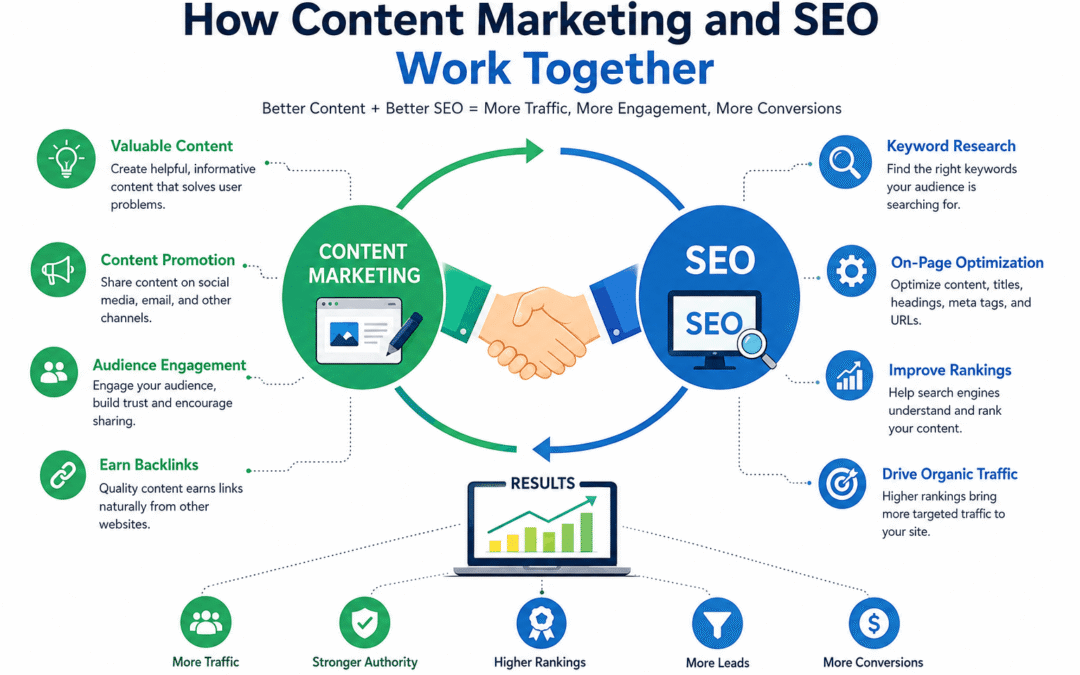
Content marketing and SEO are two important parts of a successful digital marketing strategy. While SEO helps a website appear in search engine results, content marketing gives people useful information that attracts and engages them. When these two strategies work together, businesses can increase organic traffic, build authority, earn backlinks, and generate more leads.
Many businesses focus only on publishing blog posts or only on optimizing keywords. However, the best results usually come when SEO and content marketing are planned together. From keyword research and search intent to content promotion and link building, both strategies support each other throughout the customer journey.
What Is Content Marketing?
Content marketing is the process of creating and sharing useful content to attract a specific audience. The goal is not simply to publish as many articles as possible but to provide information that answers people’s questions and helps them solve problems.
Content can include:
- Blog posts
- Guides and tutorials
- Case studies
- Infographics
- Videos
- Ebooks
- Social media content
- Industry reports
For example, an SEO agency might create a detailed guide about improving website rankings. That guide can attract visitors from search engines and can also be promoted through social media, email, guest posts, and outreach.
What Is SEO?
Search engine optimization is the process in which we improve website structure using
Some concept on the base of experience and driven result so that the website rank on the
Top page and grow business.
On-Page SEO
On-Page SEO focus on improving website structure like text,heading,image optimization,so website rank easily.
Technical SEO
Technical SEO solve the eror in website like speed enhance other loading issue covered in technical seo .
Off-Page SEO
Off-page SEO focus on link website of other high traffic website to gain traffic and also guest posting post of your website publish on the other website.
How Do Content Marketing and SEO Work Together?
Content marketing and SEO work together by combining valuable information with search visibility. SEO helps identify what people are searching for, while content marketing provides useful answers to those searches.
Keyword Research Helps Find Content Opportunities
Keyword research helps businesses understand the words and questions their target audience uses in search engines. These keywords can then be used to develop relevant content topics.
For example, instead of writing a general article about SEO, a business could target a more specific topic such as “how to build backlinks for a new website.”
This approach helps content focus on a real search need instead of being created without a clear purpose.
Search Intent Guides Better Content
Understanding search intent is another important connection between SEO and content marketing.
A person searching for “what is off-page SEO” is probably looking for an explanation. Someone searching for “best backlink tools” may be comparing different solutions.
Content should therefore match the reason behind the search. When an article satisfies the user’s intent, it has a better chance of attracting relevant visitors and keeping them engaged.
SEO Makes Content Easier to Discover
Even excellent content may receive little traffic if search engines cannot properly understand or discover it.
SEO helps content become more accessible through elements such as:
- Relevant page titles
- Descriptive headings
- Optimized URLs
- Internal linking
- Structured content
- Image optimization
- Proper indexing
This gives search engines clearer information about what a page is about.
How Content Marketing Supports Off-Page SEO
Content marketing plays a major role in off-page SEO because valuable content can create opportunities for websites to earn links and mentions from other sources.
Creating Link-Worthy Content
People are more likely to reference content that provides something useful or unique.
Examples include:
- Original research
- Statistics
- Detailed guides
- Industry studies
- Free resources
- Helpful tools
- Original case studies
A well-researched resource can become a reference for other websites and naturally attract backlinks.
Guest Posting
Guest posting can combine content creation with relationship building. Businesses can contribute useful articles to relevant websites and, where appropriate, earn a contextual link back to their own website.
The focus should always be on relevance and usefulness rather than publishing low-quality articles simply to obtain links.
Content Outreach
Content outreach involves contacting relevant website owners, journalists, bloggers, and publishers who may find a particular resource useful.
For example, if you publish an original study about SEO trends, you can reach out to websites that cover digital marketing and explain why the research may be useful to their audience.
Digital PR and Brand Mentions
Strong content can also support digital PR. Newsworthy research, expert opinions, original data, and useful industry resources may attract mentions from publications and websites.
Even when a mention does not immediately produce a backlink, it can increase brand awareness and put the business in front of a relevant audience.
How Should SEO Be Done in a Broader Marketing Strategy?
SEO should not be treated as a separate activity that only focuses on Google rankings. It can work alongside other marketing channels to create a stronger overall strategy.
SEO and Social Media
Social media can help distribute content and introduce it to new audiences. Although social shares are not a direct replacement for backlinks, social promotion can increase content exposure and create opportunities for people to discover and reference it.
SEO and Email Marketing
Email newsletters can help businesses promote new articles, guides, research, and other resources to an existing audience.
For example, an agency can publish a detailed SEO guide and send it to subscribers. Readers may share the resource, visit the website, or recommend it to others.
SEO and Paid Advertising
Paid advertising can provide immediate visibility while SEO works toward longer-term organic visibility.
A business can use paid campaigns to test different topics, offers, or landing pages and then use the insights to improve its organic strategy.
SEO and Digital PR
Digital PR and SEO can work particularly well together. Creating newsworthy content can generate media coverage, brand mentions, referral traffic, and potentially valuable backlinks.
How to Create an SEO Content Marketing Strategy
A successful strategy starts with understanding the audience and ends with measuring results.
1. Understand Your Target Audience
Identify who you want to reach and what problems they are trying to solve.
2. Perform Keyword Research
Find relevant keywords based on search demand, competition, and user intent. Focus on topics that are closely connected to your products or services.
3. Build a Content Plan
Create a list of topics and organize them into categories. This can help your website develop stronger topical coverage.
4. Create Useful Content
Write content that provides clear answers, practical information, examples, and actionable advice. Avoid creating articles only to include keywords.
5. Optimize the Content
Use your primary keyword naturally in important areas such as the title, introduction, headings, URL, and relevant sections. Also optimize internal links, images, and metadata.
6. Promote the Content
Publishing an article is only the beginning. Promote it through relevant communities, email, social media, outreach, guest contributions, and digital PR where appropriate.
7. Build Relevant Backlinks
Identify websites that are genuinely relevant to your industry and look for legitimate opportunities to earn links. Quality and relevance are more important than collecting large numbers of low-quality backlinks.
8. Measure Performance
Monitor organic traffic, rankings, backlinks, engagement, conversions, and other business goals. Use the data to identify what is working and where improvements are needed.
Common Mistakes to Avoid
Combining content marketing and SEO does not mean publishing hundreds of low-quality articles or building backlinks from unrelated websites.
Some common mistakes include:
- Keyword stuffing
- Creating thin content
- Copying competitors
- Ignoring search intent
- Buying poor-quality backlinks
- Publishing content without promotion
- Targeting unrelated keywords
- Focusing only on rankings
- Never updating older content
A sustainable strategy focuses on useful content, relevant audiences, genuine relationships, and long-term authority.
Benefits of Combining SEO and Content Marketing
When these strategies are integrated properly, businesses can benefit from:
- Increased organic visibility
- More targeted website traffic
- Stronger brand authority
- More opportunities for backlinks
- Better audience engagement
- Improved lead generation
- Greater content reach
- Long-term organic growth
The biggest advantage is that one piece of quality content can support multiple marketing activities. It can rank in search results, be shared on social media, included in an email campaign, used during outreach, and become a reference for other websites.
Final Thoughts
So, how do content marketing and SEO work together? SEO identifies opportunities, understands search behavior, and improves visibility, while content marketing provides the valuable information users are looking for. When combined, they create a strategy that can attract visitors, build authority, earn relevant backlinks, and support business growth.
For off-page SEO, the relationship is especially important. High-quality content gives businesses something worth promoting, sharing, referencing, and linking to. Instead of treating content creation and link building as separate tasks, businesses can use them together as part of a complete SEO strategy.
If your website needs stronger visibility and a more effective SEO strategy, professional on-page SEO, off-page SEO, technical SEO, guest posting, and link-building services can help you build a stronger foundation for long-term growth.